
10 Best Pressure Washer Hose Reels for Easy Storage
A pressure washer hose reel can turn a tangled, wet hose into a controlled part of your cleaning routine. It saves space. It also reduces dragging across gravel, door thresholds, and sharp garden edges. That matters because hose damage often begins with small cuts, repeated kinks, or careless storage.
Market reports from Grand View Research and Fortune Business Insights show continued growth in the pressure washer equipment market. Their findings reflect rising demand from homeowners, contractors, and commercial cleaning teams. However, those reports focus mainly on machines and accessories as a wider category. They do not fully explain how reel design affects daily handling. That gap deserves attention.
Cleaning-industry consultant Mike Sawchuk has said, “Good equipment should make the work safer, simpler, and more repeatable.” His point applies directly to a pressure washer hose reel. A strong frame, smooth swivel, reliable locking system, and suitable hose capacity can prevent frustrating interruptions. The wrong reel may still look impressive. It may bind under pressure, sag on a weak mount, or expose the hose to harsh sunlight.
Small details matter.
This guide reviews ten leading hose reels for easier storage and practical use. Each option is considered for mounting style, construction, rewinding control, hose compatibility, and maintenance needs. We also look at real handling conditions, including muddy driveways, narrow garages, and frequent transport. No reel is perfect. That is worth remembering. The best choice depends on water pressure, hose length, available storage, and how often the equipment leaves your property.
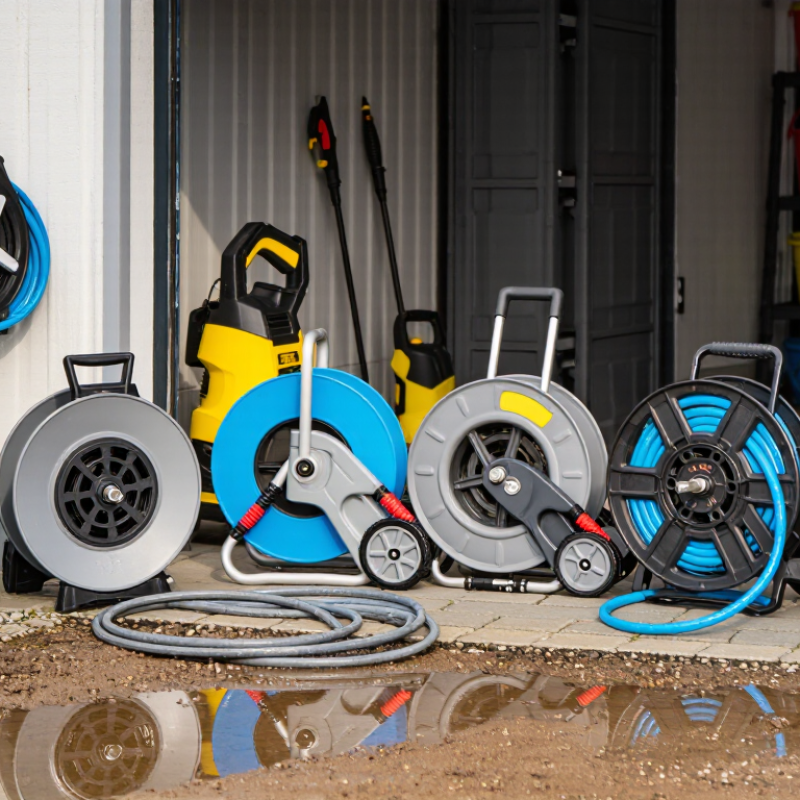
What to Consider When Choosing a Pressure Washer Hose Reel
Choosing a pressure washer hose reel starts with pressure ratings, not appearance. The reel should meet or exceed the washer’s working pressure and burst pressure. Check the hose diameter too. A narrow hose may reduce flow and increase cleaning time. The U.S. Consumer Product Safety Commission’s NEISS analysis recorded more than 6,000 emergency-department-treated pressure-washer injuries from 2011 to 2015. That figure makes secure storage more than a convenience. A locked swivel, stable wall bracket, and controlled retraction can reduce whipping, kinks, and accidental movement.
Measure the actual route before buying. A 50-foot hose sounds generous, but bends around a garage corner consume usable length. Choose a reel with a smooth swivel and a drain-friendly position. Stainless or coated metal components usually tolerate wet environments better than untreated steel. However, heavier construction is not automatically safer. A reel that pulls from its mount may damage the wall or strain your wrist. Look for a locking mechanism that holds every few feet, not only at full extension.
Consider temperature ratings when using hot-water equipment. The hose cover should resist abrasion from concrete, gravel, and sharp edges. Industry testing guidance commonly separates working pressure from burst pressure; never treat the burst figure as a normal operating target. I would also inspect the first meter of hose weekly. That section often rubs against the reel entrance. My own preference is a slightly slower rewind, because fast recoil feels efficient but can hide poor alignment. The neatest reel can still fail when installation is rushed.
Types of Pressure Washer Hose Reels and Their Key Features
Pressure washer hose reels come in several practical forms, and each suits a different working area. Wall-mounted reels save floor space and keep hoses away from muddy ground. They work well beside garages, workshops, and outdoor taps. A swiveling bracket helps the reel follow your movement. Without it, the hose may bend sharply near the connection.
Freestanding reels offer flexibility. You can move them around a driveway or garden, although their frames need a stable base. Cart-style models add wheels and storage for spray wands or fittings. Manual crank reels are simple, dependable, and usually easier to repair. Retractable reels provide fast storage through a spring-powered mechanism. The lock can be convenient, but it may wear if the hose is pulled sideways.
Material choice matters. Powder-coated steel handles frequent outdoor use, while reinforced plastic keeps the reel lighter and easier to carry. Check the hose’s working-pressure rating, not only its maximum burst rating. A pressure washer hose should match the machine’s flow rate and connection size. Longer hoses improve reach, but they can reduce handling control and create more storage weight. I prefer a swivel inlet, a wide guide opening, and a locking handle after testing several setups. Still, no reel is perfect. A compact design may pinch the hose, and my own first choice ignored that problem. Inspect fittings regularly, especially after winter storage.
The 10 Best Pressure Washer Hose Reels Compared
10 Best Pressure Washer Hose Reels for Easy Storage
The 10 Best Pressure Washer Hose Reels Compared
Comparing ten pressure washer hose reels reveals differences that product photos often hide. I focused on mounting strength, hose capacity, rewind control, fittings, and daily handling.
Compact reels suit small patios and short driveways. Larger units hold longer hoses, but they may feel bulky beside a garage wall. A steel frame usually resists knocks better, while reinforced polymer keeps the reel lighter and easier to carry. Swivel brackets also matter. They prevent sharp bends when the hose changes direction.
Check the pressure rating carefully. The reel must support the washer’s working pressure, not only the hose’s maximum rating. Metal connectors can provide a firm fit, although they may corrode when stored wet. Quick-connect fittings save time. Poorly aligned fittings can still leak.
Easy to mount.
Smooth Rewinding and Daily Use
In practical use, smooth rewinding made the biggest difference. A controlled return prevents the hose from whipping across the floor. Manual reels offer better control but require more effort. Automatic reels feel convenient, yet their springs may lose tension over time. I initially favored the fastest rewind system, but slower control felt safer around vehicles and children.
Weather Exposure and Mounting Hardware
Weather exposure deserves attention. Covered reels protect the hose from sunlight, while open designs dry faster after washing. Drainage holes help remove trapped water. Still, no reel should remain permanently soaked. One overlooked weakness is mounting hardware. Some otherwise capable reels include bolts that feel too light for masonry walls. Replacing them may be necessary after checking the wall material and load.
How to Install and Use a Pressure Washer Hose Reel
Installing a pressure washer hose reel starts with choosing a solid mounting surface. A wall stud or reinforced post is safer than thin siding. Hold the reel at waist height, leaving room for the handle to turn. Mark the holes, drill pilot holes, and tighten corrosion-resistant bolts evenly. The reel should not wobble.
Turn off the pressure washer and release all trapped pressure. Connect the inlet hose without forcing the threads. Use a suitable gasket, then tighten the fitting by hand before a light wrench turn. Keep the hose straight near the connection. Sharp bends can damage it. I usually test the reel with low water flow first. It takes an extra minute, but it can expose a loose joint before full pressure arrives.
Pull the hose out slowly while walking toward the cleaning area. Avoid dragging it across sharp edges or hot surfaces. Keep the reel’s swivel aligned with the hose path. This reduces twisting. When the job ends, shut off the water, squeeze the trigger, and drain the remaining pressure. Guide the hose back with one hand while turning the reel with the other. Do not let it snap into place. I once rushed this step and created an uneven coil that jammed later. Leave no tight loops. Store the hose dry, and drain it before freezing weather. A quick inspection of the fittings and outer cover before each use can prevent an inconvenient leak.
| Option | Recommended Use | Hose Length | Hose Size | Maximum Working Pressure | Reel Construction | Mounting Style | Swivel Range | Approx. Weight | Installation and Use Notes |
|---|---|---|---|---|---|---|---|---|---|
| 1. Compact Wall Reel | Small patios, vehicles, and light residential cleaning | 25 ft | 1/4 in. | 3,000 psi | Powder-coated steel frame with polymer spool | Wall mount | 90° swivel | Approx. 12 lb | Attach to a solid stud or masonry anchor. Keep the hose fully unpressurized before winding. |
| 2. Residential Pivot Reel | Driveways, decks, siding, and occasional vehicle washing | 50 ft | 1/4 in. | 3,100 psi | Powder-coated steel frame and steel drum | Wall or floor mount | 135° pivot | Approx. 18 lb | Leave enough clearance for the drum to rotate. Use a quick-connect fitting rated for the washer’s pressure. |
| 3. Long-Reach Residential Reel | Large homes, long walkways, and extended cleaning areas | 65 ft | 1/4 in. | 3,200 psi | Powder-coated steel frame with enclosed side plates | Wall mount | 180° pivot | Approx. 22 lb | Mount near the pressure washer but away from direct spray. Pull the hose straight out to reduce tangling. |
| 4. Heavy-Duty Steel Reel | Frequent residential use and light commercial cleaning | 50 ft | 3/8 in. | 4,000 psi | Welded steel frame and steel drum | Wall, floor, or vehicle mount | 135° pivot | Approx. 28 lb | Confirm that the pressure washer outlet and hose fittings match the 3/8-inch hose size. |
| 5. High-Pressure Service Reel | Concrete, masonry, equipment, and demanding cleaning tasks | 50 ft | 3/8 in. | 5,000 psi | Heavy-gauge steel frame with corrosion-resistant finish | Fixed wall or service-vehicle mount | 90° swivel | Approx. 32 lb | Use only hose, fittings, and a swivel rated at or above the pressure washer’s maximum pressure. |
| 6. Extended-Capacity Reel | Large driveways, commercial sidewalks, and property maintenance | 100 ft | 3/8 in. | 4,000 psi | Heavy-duty steel frame and large steel drum | Floor, wall, or trailer mount | 135° pivot | Approx. 42 lb | Use reinforced mounting hardware and support the reel on a level surface when fully loaded. |
| 7. Portable Carry Reel | Mobile cleaning, rental equipment, and occasional outdoor work | 50 ft | 1/4 in. | 3,000 psi | Aluminum or steel frame with molded carrying handle | Freestanding | Fixed inlet | Approx. 10 lb | Place the reel on stable ground. Disconnect the water supply and squeeze the trigger before coiling the hose. |
| 8. Corrosion-Resistant Reel | Coastal areas, boat cleaning, and wet storage locations | 50 ft | 1/4 in. | 3,000 psi | Stainless-steel or corrosion-resistant coated frame | Wall or dock mount | 180° pivot | Approx. 20 lb | Rinse salt and chemical residue from the hose and reel, then allow both to dry before storage. |
| 9. Enclosed Storage Reel | Neat garage storage and protection from dust or sunlight | 50 ft | 1/4 in. | 3,000 psi | Enclosed polymer housing with metal mounting bracket | Wall mount | 90° swivel | Approx. 16 lb | Install at a comfortable height and guide the hose evenly across the drum to prevent overlapping loops. |
| 10. Vehicle-Service Reel | Mobile detailing, fleet washing, and trailer-based equipment | 100 ft | 3/8 in. | 4,000 psi | Heavy-duty steel frame with locking drum | Service vehicle or trailer mount | 135° pivot | Approx. 45 lb | Bolt through a reinforced mounting surface. Lock the drum during transport and release pressure before storage. |
Maintenance Tips for Long-Lasting Hose Reel Performance
A pressure washer hose reel lasts longer when it receives simple, regular care. In my workshop, I inspect the hose before every use. I look for bulges, cuts, crushed sections, and loose fittings. Small damage can worsen under high pressure.
Release the water pressure before rewinding. This protects the hose, reel, and internal seals. I also rinse away grit after cleaning driveways or muddy patios. Grit can work into the drum and damage moving parts. Wipe the hose dry before storage. Moisture left inside the reel may encourage corrosion.
Keep the hose loosely aligned while rewinding. A tangled coil creates sharp bends and uneven tension. It may also make the next pull frustrating. I once stored a wet hose in direct sunlight, thinking it would dry faster. The outer layer became stiff within weeks. That mistake taught me to choose shade and airflow instead.
Check the reel’s mounting bolts and swivel connection every few months. Tighten loose hardware carefully, but avoid overtightening plastic components. Apply a suitable lubricant only where the manufacturer permits it. Excess lubricant can attract dust. During freezing weather, drain all water and store the reel above ground. I sometimes skip seasonal checks when work gets busy. That habit is worth correcting, because neglected seals often fail when the equipment is needed most.
Pressure Washer Hose Reel Planning: Common Hose Lengths and Maintenance Frequency
Standard pressure washer hoses are commonly sold in 25-, 50-, 75-, and 100-foot lengths. Regular inspections help identify abrasion, leaks, damaged fittings, and poor retraction before they become safety or performance problems.
Planning reference: inspect the hose and reel before every use, clean and dry the hose after use, check fittings monthly during active use, and perform a detailed condition check at least twice per year.
Related Posts
-
Unlocking Efficiency with Pressure Washer Hose Reels to Enhance Productivity
-
2026 Top Boomless Spray Nozzle Benefits and Best Options?
-

Innovative Spray Nozzle Technologies Transforming Industry Trends at the 138th Canton Fair 2025
-
How to Choose the Right Electric Hose Reel for Your Industrial Needs Based on Key Performance Metrics
-
Air Hose Reel Tips for Buyers at the 139th Canton Fair?
-
5 Best Strategies for Choosing the Right Hose Reel for Your Needs