
China Best Villa Aluminum Window Door Manufacturer
Choosing the right Villa Aluminum Window Door manufacturer affects comfort, security, appearance, and long-term maintenance. A villa is not merely a collection of walls and glass. It is a living environment where sunlight, rain, wind, and daily movement meet.
Architect Glenn Murcutt once said, “The building should be a part of the landscape.” This principle applies strongly to aluminum doors and windows. Slim frames can preserve views of gardens and water features. Correct glass selection can soften intense afternoon heat. Proper drainage can protect the threshold during heavy rain.
A reliable manufacturer studies these details before recommending a product. Experience matters. Factory testing matters. So does careful installation guidance. A beautiful frame means little when water enters through a poorly sealed corner.
The best Villa Aluminum Window Door solutions balance design with measurable performance. They should support thermal insulation, airtightness, sound reduction, and safe operation. Powder-coated aluminum can provide durable color. Multi-point locks can improve resistance against forced entry. However, specifications alone do not guarantee success.
Installation is often the weak link.
A responsible supplier should explain tolerances, hardware care, glass options, and warranty conditions clearly. Site conditions may also challenge the original design. Coastal salt, strong sunlight, or uneven masonry can change the result. Even experienced teams sometimes need to revise their assumptions.
That honesty builds trust. A manufacturer should not promise perfection. It should provide tested systems, transparent documentation, and practical support from measurement to completion. The strongest partnership begins with accurate questions, not impressive brochures.
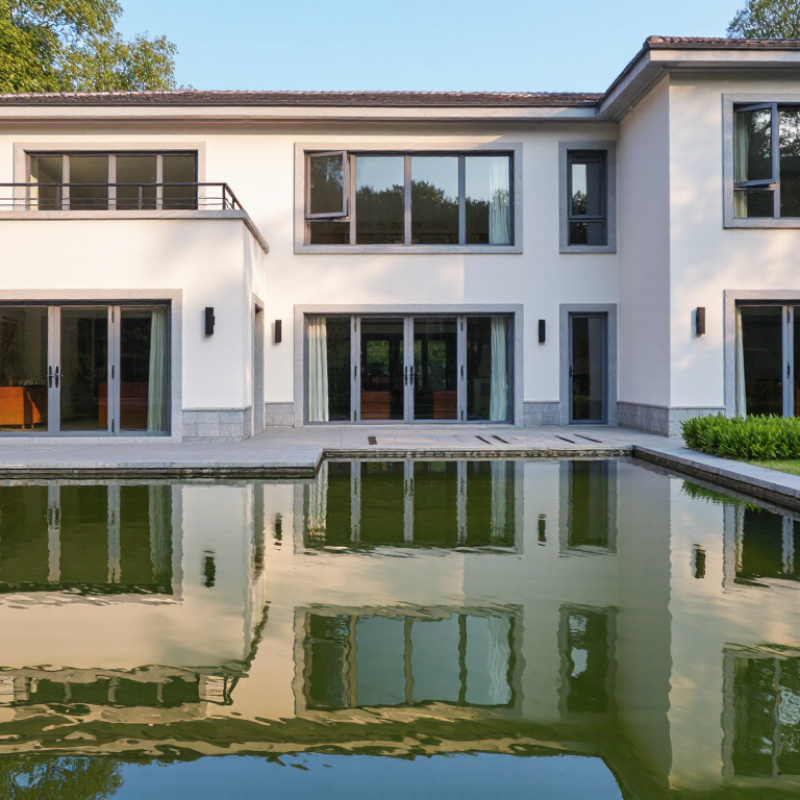
Company Profile and Role in the Villa Window and Door Industry
A reliable villa window and door manufacturer must understand more than aluminum profiles. It must understand how families use their homes. Our company develops aluminum windows and doors for villas, private residences, and small luxury developments. We combine workshop experience with practical engineering support.
Our team reviews opening sizes, wall conditions, glass weight, drainage paths, and local weather exposure before production. This process helps prevent common problems, such as difficult operation, water leakage, and uneven installation gaps. We use measured drawings, sample sections, and documented quality checks during fabrication. Each frame is inspected for surface finish, hardware alignment, seal placement, and dimensional accuracy.
Details matter greatly.
Our role in the villa window and door industry is not limited to supplying finished products. We support architects, contractors, and property owners with technical suggestions and installation guidance. Site feedback has taught us that elegant designs can fail when maintenance access is ignored. We now discuss cleaning, replacement parts, ventilation, and future adjustment before confirming orders.
We do not get every decision right. Some projects require revisions after the first review. That is part of responsible manufacturing. We record these lessons and improve our drawings, production controls, and communication. A dependable supplier should offer stable quality, clear specifications, realistic lead times, and responsive after-sales support. These practices build trust gradually, one villa and one carefully fitted opening at a time.
China Best Villa Aluminum Window Door Manufacturer - Company Profile and Role in the Villa Window and Door Industry
Typical Thermal Performance of Window Glazing
Lower U-values indicate better thermal insulation. The following representative center-of-glazing values show how advanced glazing systems can improve energy performance in villa window and door applications. Actual results vary according to frame design, spacer technology, gas filling, coating, and installation quality.
Data reference: representative engineering values commonly reported for standard architectural glazing systems. The U-value of a complete window or door also includes frame, edge-of-glass, hardware, and installation effects.
Aluminum Materials and Design Features for Luxury Villas
Luxury villa windows need more than a bright appearance. In our project experience, design begins with climate, structure, and daily use. We commonly select 6063-T5 or 6063-T6 aluminum for stable profiles and precise machining. A thermal-break system separates inner and outer aluminum with insulating polyamide strips. This reduces heat transfer around large openings. It does not solve every energy problem. Glass specification, installation gaps, and external shading still matter.
For tall sliding doors, reinforced profiles limit deflection under glass weight and wind pressure. Multi-point locks, stainless steel rollers, and adjustable hinges support smoother operation over time. EPDM seals, sloped tracks, and concealed drainage paths help control water. Small details decide whether a villa stays quiet during heavy rain. A wider frame is not always better. It can increase weight and reduce usable glass. That assumption deserves testing.
Finish selection should match the building’s exposure. Powder-coated surfaces provide consistent color, while anodized finishes create a harder metallic appearance. Near the coast, coating thickness, fastener quality, and drainage require extra inspection. Slim sightlines can pair with low-e double or triple glazing for refined interiors. However, ultra-slim profiles may reduce thermal performance or hardware capacity. We check corner accuracy, sash alignment, and air leakage before delivery. On site, experienced installers verify plumb, level, and sealant joints instead of hiding small errors. Some projects need revision.
Manufacturing Process and Quality Control Standards
A reliable villa aluminum window door manufacturer starts with controlled material selection. Aluminum profiles should be checked for alloy grade, wall thickness, straightness, and surface defects before production. The U.S. Department of Energy reports that windows can cause 25–30% of residential heating and cooling energy use. Therefore, thermal breaks, low-conductivity spacers, and accurate gasket compression deserve close attention.
The manufacturing process usually includes cutting, CNC machining, corner assembly, coating, glazing, and final adjustment. Each stage needs measurable controls. For example, air leakage can be tested under ASTM E283, while water penetration follows ASTM E331. Structural performance should be verified through ASTM E330 testing.
Coating thickness, often measured at several points, helps reveal uneven coverage around corners and drainage holes.
Small gaps matter.
Quality control should not end with visual inspection. ISO 9001-based procedures can link each frame to material records, operator checks, and test results. A 2023 International Energy Agency report states that buildings consume about 30% of global final energy, making envelope performance increasingly important.
Still, laboratory results may not match a dusty construction site. This is where many projects need improvement. Manufacturers should inspect samples after transport, test hardware repeatedly, and document corrective actions instead of hiding minor failures.
A clean frame is not automatically a dependable one.
Customization, Energy Efficiency, and Security Solutions
China Best Villa Aluminum Window Door Manufacturer
Customization, Energy Efficiency, and Security Solutions
A villa window should fit the building, climate, and daily habits. Standard sizes often leave uncomfortable gaps around large openings. Custom aluminum systems can match wall thickness, glazing dimensions, and preferred ventilation patterns. Slim profiles also create wider views, but a narrow frame is not automatically efficient.
The International Energy Agency reports that buildings use about 30% of global final energy and produce roughly 26% of energy-related emissions. The U.S. Department of Energy estimates that windows may cause 25–30% of residential heating and cooling energy use. Thermal breaks, low-emissivity glazing, insulated spacers, and accurate installation can reduce unwanted heat transfer. Performance depends on the complete assembly, not aluminum alone. This detail is easy to overlook.
Security needs equal attention. Laminated glass, reinforced corners, multi-point locks, and tested hardware can improve resistance against forced entry. Door thresholds should also manage rainwater without creating trip hazards. Project reviews often reveal a weakness: attractive doors may still have poor drainage or weak installation joints. Energy labels and test reports should be checked before production.
Tips: Ask for tested U-value, air-tightness, water-tightness, and wind-load results. Confirm the glass specification, frame depth, locking points, and warranty terms. Request installation drawings early. Small details matter.
| Solution Area | Key Specification | Typical Data or Range | Practical Benefit | Relevant Reference |
|---|---|---|---|---|
| Profile Customization | Thermally broken aluminum profile | Polyamide thermal barrier commonly 24–34 mm; profile depth typically 60–120 mm, depending on system design | Reduces heat transfer through the frame and supports project-specific dimensions | EN 14024; ISO 10077-2 |
| Aluminum Alloy | Extruded architectural aluminum | 6063-T5 or 6063-T6 are commonly used for window and door extrusions | Provides a balance of corrosion resistance, surface quality, and structural performance | ASTM B221; EN 755 |
| Glazing Options | Double or triple insulating glass unit | Double glazing: commonly 24–32 mm overall; triple glazing: commonly 36–52 mm overall; cavity usually 12–16 mm | Supports improved thermal insulation and acoustic comfort | EN 1279; ISO 10077-1 |
| Low-E Glass | Coated low-emissivity glass with inert-gas cavity | Center-of-glazing Ug approximately 0.7–1.1 W/m²K, depending on glass build-up | Helps reduce winter heat loss while maintaining daylight transmission | EN 673; ISO 10292 |
| Whole-Window Energy Efficiency | Frame and glazing combined U-value | Typical thermally broken systems: Uw approximately 1.0–2.0 W/m²K; final value depends on size, glass, spacer, and frame ratio | Can reduce heating and cooling loads when correctly specified and installed | ISO 10077-1; ISO 10077-2 |
| Solar Control | Solar-control or selective low-E glazing | Solar factor g commonly selected within approximately 0.25–0.60 according to orientation and climate | Helps manage solar heat gain and indoor glare | EN 410 |
| Air Tightness | Multi-chamber seals and compression gaskets | High-performance assemblies can achieve EN 12207 Class 4 when tested as a complete unit | Limits uncontrolled drafts and improves indoor comfort | EN 1026; EN 12207 |
| Water Tightness | Concealed drainage channels and weather seals | Common project design targets range from 600–1500 Pa, subject to window type and exposure | Helps protect interiors from wind-driven rain | EN 1027; EN 12208 |
| Wind Resistance | Reinforced profiles and engineered hardware | Typical design pressure may range from 1600–2400 Pa; structural calculation is required for large openings | Supports stable operation in exposed villa locations | EN 12210; EN 12211 |
| Security Configuration | Multi-point locking, reinforced keeps, and laminated safety glass | Resistance classes RC2 or RC3 may be specified for tested assemblies; security depends on the complete window or door set | Improves resistance to forced-entry attempts | EN 1627–EN 1630 |
| Acoustic Performance | Asymmetric or laminated acoustic glazing | Weighted sound reduction index Rw commonly approximately 35–45 dB, depending on the complete assembly | Helps reduce traffic, neighborhood, and outdoor noise | EN ISO 10140; EN ISO 717-1 |
| Safety Glazing | Tempered or laminated safety glass | Common thicknesses include 5–12 mm per pane, selected according to size, loading, and safety requirements | Reduces injury risk in impact-prone areas when correctly specified | EN 12150; EN 14449 |
| Surface Finish | Powder coating or anodizing | Powder coating specifications may follow AAMA 2603, 2604, or 2605; anodized finishes may follow AAMA 611 | Provides color selection and protection against normal atmospheric exposure | AAMA 2603–2605; AAMA 611 |
| Opening Styles | Casement, tilt-and-turn, sliding, lift-and-slide, folding, and pivot systems | Configuration, sash size, glass weight, and hardware capacity must be checked for each project | Allows layouts to be adapted to ventilation, views, access, and façade design | Project-specific engineering and testing |
| Technical note: Performance values are indicative ranges for properly designed and installed aluminum window and door assemblies. Actual results depend on opening dimensions, glass configuration, hardware, drainage, installation details, local climate, and the required testing standard. | ||||
How to Select a Reliable China-Based Manufacturer
Choosing the best villa aluminum window door manufacturer in China requires more than comparing prices. A reliable supplier should explain alloy grades, thermal-break systems, glass options, and surface treatments clearly. Ask for recent test reports, production photos, and project references. A polished website proves little.
Request a physical sample before approving large quantities. Check corner joints, drainage holes, gasket contact, handle movement, and coating consistency. For coastal villas, confirm salt-spray resistance and suitable hardware. For cold regions, review U-values and thermal-bridge details. The supplier should provide measured drawings and installation guidance, not vague promises.
Factory communication matters. Can the technical team answer questions within one working day? Do they identify design risks before production? Ask how they manage color variation, damaged glass, replacement parts, and late changes. A written inspection plan adds protection. It should cover dimensions, opening direction, glass thickness, packaging, and loading photos. I would also verify independent inspection options, because internal quality checks may not reveal every weakness. Some manufacturers offer impressive customization but lack stable project management. That difference becomes expensive on a villa site. Reliable cooperation is built through documented details, honest limitations, and consistent follow-up.