
Top Hydrocell Golf Cart Battery Features to Compare?

Choosing a Hydrocell Golf Cart Battery is not just a matter of matching a price tag to a cart. A useful comparison starts with the cart’s required voltage, battery-tray dimensions, terminal layout, and typical workload. A quiet neighborhood route places different demands on a battery than steep hills, frequent stops, or long days between charges. Small details matter.

Before comparing advertised capacity, confirm that each battery fits the cart and works with its charger. Then review usable energy, continuous output, battery-management protections, charging time, weight, warranty, and stated cycle life. Claims are useful only when their test conditions are clear. A cycle-life figure without temperature or discharge details can be hard to compare fairly. No spec sheet tells the whole story.

This guide looks at the features that influence everyday performance, not just the numbers that look impressive in a listing. It also considers practical questions: How far does the cart travel on a typical charge? Will added battery weight affect handling? Is support available if charging behavior seems unusual? I would not treat a longer warranty as proof of better performance; its terms deserve a close read. Even a careful checklist cannot predict every route or driving habit, and that limitation is worth admitting. Use the comparisons to narrow your options, then verify fit and compatibility with the cart and battery documentation before buying.
Top Hydrocell Golf Cart Battery Features to Compare?

Battery Chemistry and Construction

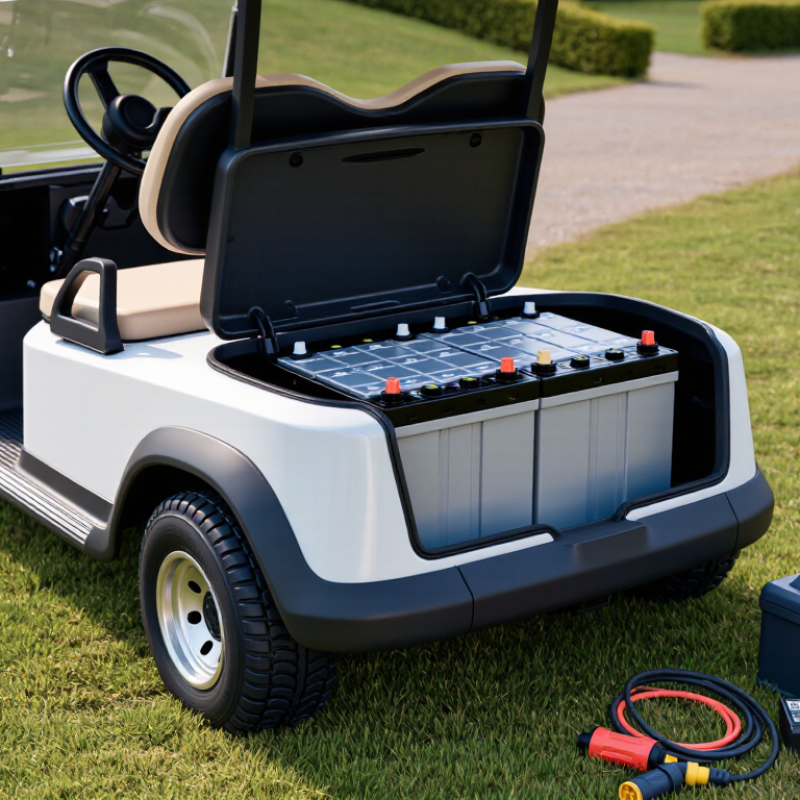
Battery chemistry shapes how a golf cart battery delivers power, handles charging, and ages. Many deep-cycle batteries use lead-acid chemistry, with liquid electrolyte inside each cell. Their sturdy cases and familiar charging needs suit regular cart use, but they require periodic inspection. Check the manual before topping up any serviceable cell. Some batteries are sealed, so opening them is not appropriate. Lithium batteries are lighter and may recharge faster, though their chargers and control systems must match the battery.

Construction matters just as much. Look for a rigid case, secure terminals, and clear labels showing voltage and capacity. In a lead-acid battery, plates and separators sit within the cell; damage or poor maintenance can reduce usable capacity.

A battery can look clean and still perform poorly. That part is easy to miss. Compare the rated capacity under the same testing conditions, rather than relying on a larger-looking number. Cart weight, hills, and passenger load also affect real-world range.

Tips: Ask whether the battery is flooded or sealed, and confirm its charging requirements. Inspect terminal covers and case seams for looseness or cracks. If the cart sits unused, verify the recommended storage charge; guessing can shorten battery life. I would not judge construction from appearance alone. Specifications and service records provide better evidence, though records are sometimes incomplete.

Voltage, Capacity, and Golf Cart Compatibility

Voltage is a hard compatibility limit. Many golf carts use 36- or 48-volt systems, but the battery layout varies. A 36-volt pack may contain six 6-volt batteries; a 48-volt pack may use six 8-volt or eight 6-volt batteries. Check the cart’s manual, controller label, and charger rating before comparing options. Matching voltage matters more than choosing the largest capacity.

Capacity, measured in amp-hours (Ah), estimates how much charge a battery can deliver under specified conditions. It does not translate directly into a guaranteed number of holes. The U.S. Department of Energy and Idaho National Laboratory’s Battery Test Manual for Electric Vehicles uses controlled discharge current and temperature for capacity testing. So compare Ah ratings taken at similar test rates. Real results can still differ with hills, passenger weight, tire pressure, and driving habits. The comparison is useful, but not perfect.

Tips: Photograph the battery tray and cable connections before shopping. Check pack voltage, available space, terminal position, charger compatibility, and the battery’s stated Ah test rate. If switching battery chemistry, confirm that the controller and charger support it. Small mismatches can mean poor charging or a pack that simply will not fit.

Cycle Life, Charging Speed, and Operating Performance

Top Hydrocell Golf Cart Battery Features to Compare?

Cycle life is useful only when the test conditions are clear. Compare the stated number of cycles at a specific depth of discharge, not just the largest figure on a product sheet. A battery used for short trips on a flat course may age differently from one powering long rounds on hilly paths. Temperature, charging habits, and load all matter. Details matter.

Charging speed depends on both the battery’s charge acceptance and the charger’s output. Check how long a typical recharge takes, and whether that estimate assumes a nearly empty battery or a partial top-up. For example, a cart parked between morning and afternoon rounds needs a charging plan that fits that break. A fast charger is not automatically a better match. Confirm compatibility and follow the battery maker’s recommended settings.

Operating performance is easiest to judge under realistic conditions. Compare usable capacity, voltage stability under load, and performance on inclines with passengers aboard. Note how the cart behaves near the end of a long day, when lights or accessories may also draw power. Keep records of charging time and range; estimates can be imperfect. That is worth admitting. Real use may not match a neat laboratory rating, so look for test data and warranty terms that explain what the figures mean.

Top Hydrocell Golf Cart Battery Features to Compare: Cycle Life, Charging Speed, and Operating Performance

Typical lead-acid and LiFePO₄ battery characteristics, shown as a relative index. For each feature, the LiFePO₄ reference value is set to 100; higher scores indicate more cycles, faster charging, or greater round-trip efficiency.

Illustrative estimates use representative values of 400 vs. 3,000 cycles, 9 vs. 5 hours to recharge, and 80% vs. 96% round-trip efficiency. Actual performance varies with battery model, charger, depth of discharge, temperature, and operating conditions.

Safety Features, Maintenance, and Weather Resistance

When comparing Hydrocell golf cart batteries, look beyond capacity and check practical safety details. The case should resist cracking, and terminals should accept secure covers. A battery that shifts in its tray can strain cables over rough paths. Check that the tray holds it firmly. That matters.

Maintenance needs depend on battery construction. If the battery has accessible water cells, follow its manual for inspection and topping up; sealed batteries should not be opened. Keep terminals clean and dry, and use the specified charger. A clean-looking battery can still hide a loose connection. Maintenance schedules are only a starting point; dusty storage and frequent use may change what needs attention.

Weather resistance is not the same as weatherproofing. Check the stated limits for temperature, moisture, and storage, especially if the cart stays outdoors. Heat can speed battery aging, while cold may reduce available power. After rain or washing, inspect the battery area for standing water and corrosion. Small checks help. I would not assume a covered cart stays dry in every storm; wind-driven rain can reach the tray. Compare warranty terms and care instructions, too, since protection varies by battery design.

Top Golf Cart Battery Features to Compare: Safety, Maintenance & Weather Resistance

Feature to Compare Flooded Lead-Acid AGM Lead-Acid LiFePO₄ Lithium
Typical nominal voltage per battery 6 V or 8 V; confirm the cart’s system voltage and battery count. Commonly 6 V or 8 V; match the existing system configuration. Often sold as a cart-specific pack; verify pack voltage and controller compatibility.
Capacity and usable energy Compare amp-hour ratings at the same discharge rate; frequent deep discharges can shorten service life. Compare amp-hour ratings and the manufacturer’s stated test rate; avoid comparing ratings taken at different rates. Check rated amp-hours, usable capacity, and battery-management-system limits.
Routine maintenance Requires periodic electrolyte-level checks and distilled-water top-ups; keep terminals clean. Normally no water top-ups; inspect terminals and case condition regularly. Normally no watering; inspect connections and follow storage and charging guidance.
Charging safety and ventilation Can release hydrogen during charging; charge in a well-ventilated area and keep sparks and flames away. Sealed, valve-regulated construction can still vent gas under fault or overcharge conditions; use a suitable charger. Look for an integrated battery management system with protection appropriate to the pack; use a compatible charger.
Cold-weather use Available capacity and cranking performance can decrease in cold conditions; a discharged battery is more vulnerable to freezing. Cold reduces available capacity; follow the battery maker’s temperature limits for charging and storage. Cold reduces available power; charging below freezing may be restricted unless the pack has suitable low-temperature protection.
Heat and storage conditions High temperatures accelerate aging and water loss; store charged and check electrolyte as directed. Excessive heat can shorten service life; observe the rated operating and storage temperature range. Avoid prolonged exposure to high temperatures; follow the specified limits for operation, charging, and storage.
Moisture and enclosure protection Battery compartments should be ventilated and protected from standing water; check for corrosion and leakage. A sealed case helps contain electrolyte in normal use but does not automatically mean the battery is waterproof. Check the pack’s stated ingress-protection rating; do not assume water resistance without a documented rating.
Charger compatibility Use a charger profile intended for the battery’s voltage and flooded chemistry. Use an AGM-compatible charging profile; avoid settings intended for flooded batteries unless approved. Use a charger specified for the pack’s chemistry, voltage, and BMS requirements.
Fit and installation checks Measure tray dimensions and confirm terminal layout, cable reach, and secure hold-downs. Check group size, terminal orientation, weight, and clearance before installation. Confirm pack dimensions, mounting, system voltage, controller compatibility, and any required wiring changes.

Values and requirements vary by model. Always follow the battery and golf cart manufacturers’ specifications for charging, installation, temperature limits, and maintenance.

Warranty, Price, and Long-Term Ownership Costs

When comparing golf-cart batteries, read the warranty beyond its headline term. Check whether coverage is prorated, whether labor and freight are included, and what happens after deep discharge or long storage. Ask for cycle limits in writing. Small print matters.

Then compare ownership cost, not just the checkout price. Add the charger, installation, electricity, maintenance, and likely replacement interval. BloombergNEF’s 2024 Battery Price Survey put average lithium-ion pack prices at $115 per kilowatt-hour, down 20% from 2023. That is a market benchmark, not a golf-cart retail quote. Still, it shows why prices can shift. NREL’s Battery Lifetime Analysis and Simulation Tool models battery aging against temperature and use, so a cart left hot and frequently discharged may not match a warranty’s ideal conditions.

A practical estimate is total cost over your planned ownership period, divided by years of use. Compare the same capacity and usable energy; a cheaper pack may provide less usable runtime. I would also ask how warranty claims are tested. That part can be unclear. Keep receipts and note charging habits, even if logging every charge feels excessive. A shaded garage and regular charging may matter more than a small upfront discount.