10 Best Spray Nozzles for Industrial Applications

Industrial spray nozzles shape more than a spray pattern. They influence cooling, coating thickness, cleaning coverage, and water use. The U.S. Geological Survey’s 2015 water-use assessment recorded about 14.8 billion gallons per day of industrial water withdrawals nationwide. That figure is a useful reminder: even small process losses can matter across a plant.

A spray nozzle specialist should be able to explain how pressure, flow rate, droplet size, and spray angle affect a specific application. Atomization researcher Arthur H. Lefebvre’s work highlights why droplet formation matters to spray performance. This guide compares ten nozzle types by practical factors, including material compatibility, maintenance demands, and pattern consistency. It also considers the details operators see on the floor: a clogged orifice, uneven coverage on a moving belt, or mist drifting away from its target.

No single nozzle is best everywhere. A choice that works for rinsing may perform poorly in precision coating. The right match depends on the liquid, operating pressure, target, and production conditions. Some trade-offs remain. A durable nozzle may cost more upfront, while a low-cost option may need frequent attention. This comparison aims to make those choices clearer, while recognizing that published specifications cannot replace a real-world process test. Small details matter.
10 Best Spray Nozzles for Industrial Applications

How Industrial Spray Nozzles Work and What They Do

Industrial spray nozzles turn pressurized liquid into a controlled pattern. Liquid passes through an opening; its shape and pressure influence the spray angle, flow, and droplet size. A flat fan spreads liquid across a surface, while a hollow cone concentrates droplets around a circular edge. Air-assisted designs mix compressed air with liquid to create finer droplets. Each pattern suits different work, such as rinsing, cooling, coating, or dust suppression.

The details matter. Larger droplets can reach a target with less drift, while finer droplets may improve coverage but evaporate more readily. The U.S. EPA’s WaterSense specification for commercial pre-rinse spray valves sets a maximum flow of 1.28 gallons per minute. That figure is a useful reference, not a universal target for industrial processes. Different tasks need different flow and impact. A worn or partly blocked orifice can distort the pattern and change water use. Small changes matter. Operators can compare the spray pattern and measured flow with the nozzle’s specifications during routine checks. Yet a visually even spray does not prove uniform application. That is easy to miss. Real process conditions, including pressure changes and liquid viscosity, can alter performance. A brief test under operating conditions may reveal more than a catalog description.

Key Factors for Choosing a Nozzle for Industrial Use

10 Best Spray Nozzles for Industrial Applications

Key Factors for Choosing a Nozzle for Industrial Use

A nozzle should match the job, not just the pipe connection. Start with the required flow rate, operating pressure, spray pattern, and target coverage. A flat-fan pattern can suit conveyor washing, while a full-cone pattern may cover a tank interior more evenly. Check the liquid’s temperature, viscosity, and chemical compatibility against nozzle materials. A mismatch can cause corrosion, clogging, or uneven output. Small details matter.

For air-atomizing applications, include compressed-air demand in the selection. The U.S. Department of Energy’s Improving Compressed Air System Performance sourcebook estimates that compressed-air systems use about 10% of industrial electricity in the United States, with shares reaching 30% at some facilities. That makes nozzle air consumption worth checking, especially on multi-nozzle lines. Also compare droplet size and required surface impact; a finer mist is not always better. Pressure readings alone can mislead if filters are dirty or supply lines are undersized. We sometimes overlook that.

Tips: Test the pattern with clean water before production. Place a target sheet at the actual working distance, then inspect for dry bands and overspray. Record pressure and flow. Recheck after wear or a process change.

Ten Industrial Spray Nozzle Types Compared by Performance

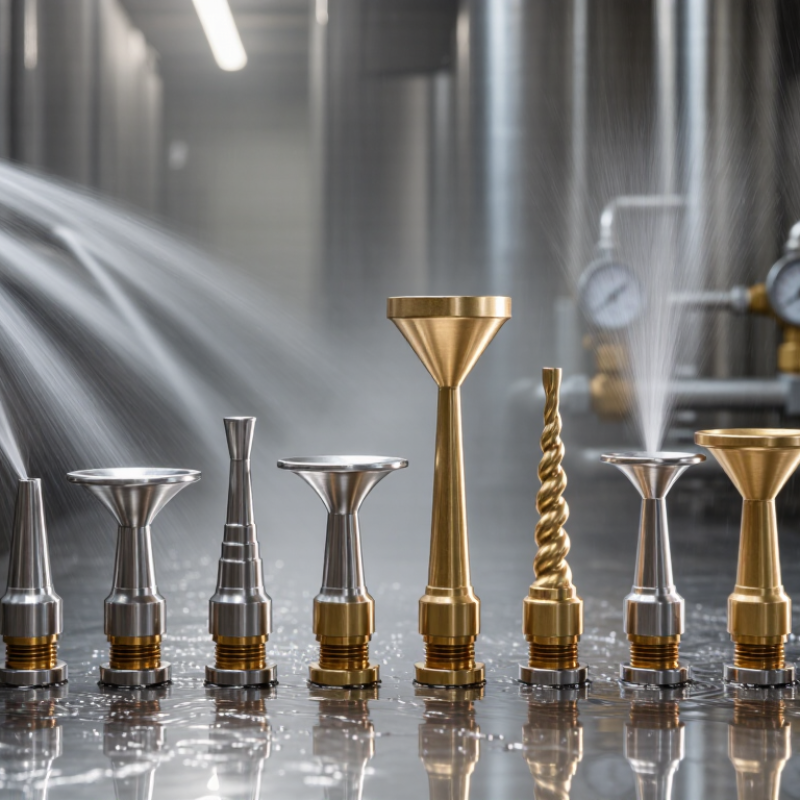
Industrial spray performance depends on droplet size, coverage, pressure, and fluid properties—not nozzle names alone. A full-cone nozzle lays a dense circular pattern for tank washing. A hollow-cone model sprays around the perimeter, often useful for cooling or gas scrubbing. Flat-fan nozzles cover a strip for belt rinsing, while solid-stream designs reach farther but cover less area. Simple, but not interchangeable.

Spiral nozzles produce broad patterns with relatively open passages, though distribution may vary across the spray. Deflection nozzles spread liquid into a sheet at low pressure; impact and angle affect consistency.

Air-atomizing nozzles create fine droplets for coating. Hydraulic atomizers use liquid pressure instead of compressed air, but may need higher pressure for comparable fineness. Rotary atomizers use rotation to form droplets, though moving parts add maintenance. Trade-offs matter.

Misting nozzles make very small droplets for humidification or evaporative cooling, but tiny openings can clog when water quality is poor. Compare all ten types by flow rate, spray angle, droplet size, pressure, and wear resistance under actual operating conditions. A catalog pattern may not match a hot, viscous process. Test at the real temperature and flow. Fine spray is not always better; drift and evaporation can reduce the liquid reaching its target.

Matching Nozzle Designs to Industrial Applications

Matching a spray nozzle to its task starts with the required pattern, not the catalog description. Full-cone nozzles distribute liquid across a broad, relatively even area, making them useful for tank washing or parts rinsing. Flat-fan designs form a narrow sheet that suits conveyor cleaning and surface coating. Hollow-cone patterns can support cooling or gas conditioning where contact around droplets matters. For fine atomization, air-assisted nozzles may help, but they need a suitable air supply.

Fit matters.

Operating conditions can change the result. Check flow rate, pressure, liquid viscosity, temperature, and the material being sprayed. A nozzle that performs well with clean water may clog when the process fluid carries solids. In a wash line, for example, compare the spray width at the actual nozzle height, not just on a bench. Observe coverage along the edges. Small gaps matter.

Material choice also affects service life, especially with abrasive fluids or corrosive cleaning solutions. Maintenance access counts too; a nozzle that is difficult to inspect may stay partially blocked longer than expected.

Test it first. Field measurements are useful, though they rarely capture every shift in temperature or production load. A practical selection may need adjustment after installation, and that is worth admitting.

Installation, Inspection, and Maintenance of Spray Nozzles

Correct installation begins with a cool, depressurized system and clean pipework. Check that the nozzle type, spray angle, and flow capacity suit the process conditions. Match the nozzle’s orientation to the intended coverage, then tighten it according to the equipment instructions. Too much force can damage threads or seals. Small details matter. Flush the line before fitting the nozzle so debris does not block the orifice on startup.

During inspection, compare the spray pattern with its normal baseline. Look for streaks, gaps, dripping, or a change in sound. Measure pressure and flow when possible; a worn opening may pass more liquid even when it looks clean. In practice, visual checks alone can be misleading. A nozzle can appear fine and still distribute unevenly. Check for deposits, corrosion, and damaged threads, using suitable lighting and eye protection.

For maintenance, isolate the system and follow site procedures before removing any parts. Clean with a method compatible with the nozzle material and process fluid. Avoid sharp wire or tools that could enlarge the orifice. Replace worn seals, then reinstall and verify the spray pattern under operating conditions. Record inspection dates, pressure, and observed defects. Records help reveal gradual changes, though rushed notes can miss useful detail. Take the extra minute.

Spray Nozzle Flow vs. Operating Pressure

Industrial spray nozzle performance depends on operating conditions. This chart shows idealized relative flow for the same nozzle as pressure changes.

For a fixed nozzle orifice and liquid, flow varies approximately with the square root of pressure. Use the nozzle manufacturer’s performance data for actual flow rates. During inspection, check operating pressure, spray pattern, and signs of clogging or wear.